


When Equity Bubbles Burst: How Today’s Risks Differ from the Dot-Com Era
Key Takeaways
Similarities between current tech sector valuations and the late 1990s dot-com bubble raise questions about how vulnerable banks are to a technology-led correction.
In contrast to the equity-fueled dot-com era, today’s AI buildout largely has been led by stronger, more diversified tech companies and funded internally or through debt obtained through private credit or other nonbank intermediaries.
Banks have grown their lending to nonbanks significantly, so a tech-led market correction could reach banks through less-visible and harder-to-contain channels than during the dot-com crash.
Higher public debt and lingering inflation risks could limit policymakers’ ability to respond as quickly and forcefully as they did in 2001.
Today’s AI- and Big Tech-driven equity markets have drawn comparisons to the late 1990s, when enthusiasm for the internet fueled the dot-com bubble.[1] If markets were to correct sharply again, how vulnerable would the banking system be?
The answer depends on where leverage resides, who absorbs losses, and how exposed banks are through lending, funding, and fee-generating activities.
Unlike the 2008 Global Financial Crisis (GFC), which originated within the banking system from excess leverage, poor underwriting, and concentrated housing exposure, the dot-com crash was primarily an equity and corporate credit event. Despite a severe market decline and recession, it did not trigger a systemic banking crisis.
Today, however, the environment differs in two important respects: private credit and nonbank lending play a much larger financing role, and policymakers may have less room to respond with monetary and fiscal support.
Changes to the Financing Ecosystem
Today’s market shares certain patterns with that of the late 1990s in its elevated equity valuations, concentrated market leadership, and enthusiasm surrounding potentially transformative technology,[2] as well as rising debt levels.[3] One key difference is that today’s financing structure creates different channels through which stress could reach banks.
During the dot-com era, internet startups largely relied on equity financing. Venture capital investors funded rapid growth with the expectation of early IPOs, often before companies became profitable. In 1999, technology firms accounted for 78 percent of all 476 IPOs, and more than three quarters of all companies had negative earnings per share when they went public.[4] Pets.com became emblematic of the era, collapsing just eight months after its IPO.
Although remembered as an equity bubble, the dot-com era also led to significant credit losses, particularly in the debt financing of telecommunications infrastructure. Banks took large write-downs on loans to firms such as WorldCom and Global Crossing[5] and later faced litigation tied to Enron and WorldCom underwriting.[6]
Today’s financing landscape is markedly different. Between 2023 and 2025, only 216 companies went public, fewer than one-quarter of them technology firms.[7] Private capital now finances much of the industry’s growth, allowing companies to remain private longer.[8] Meanwhile, the leading technology firms funding AI buildout are more diversified, better capitalized, and more profitable than the companies that dominated the dot-com era, funding much of their investment internally.[9] Some private technology firms remain unprofitable despite lofty valuations,[10] while their limited financial disclosure makes those risks harder to assess. Although many of the most important AI companies remain private, developments at those firms can still materially affect the valuations of publicly traded technology companies, creating broader market spillovers.[11]
Beyond that, debt plays a much larger role in financing today’s AI buildout,[12] with much of that leverage residing outside the banking system through private credit and other nonbank lenders. Since the GFC, lending to nondepository financial institutions has been banks’ fastest-growing loan category.[13] As a result, a technology-led correction could reach banks through less visible—and potentially harder-to-contain—channels than it did during the dot-com era.
The Dot-Com Bust: Market Shock, Limited Banking Stress
After a dramatic late-1990s rally fueled by enthusiasm for internet and technology stocks, equity markets reversed in March 2000. The NASDAQ fell roughly 75 percent from its peak, erasing more than $5 trillion in market value and taking about 15 years to fully recover.[14]
The correction triggered a mild recession marked by weaker corporate profits, declining business investment, rising corporate defaults, and higher commercial and industrial loan losses.[15] Despite these pressures, the U.S. banking system remained resilient. Banks entered the downturn in strong financial condition, and although higher loan loss provisions reduced earnings, stronger net interest margins and securities gains largely offset the decline, leaving industry profitability relatively stable (see Chart 1).[16]
CHART 1
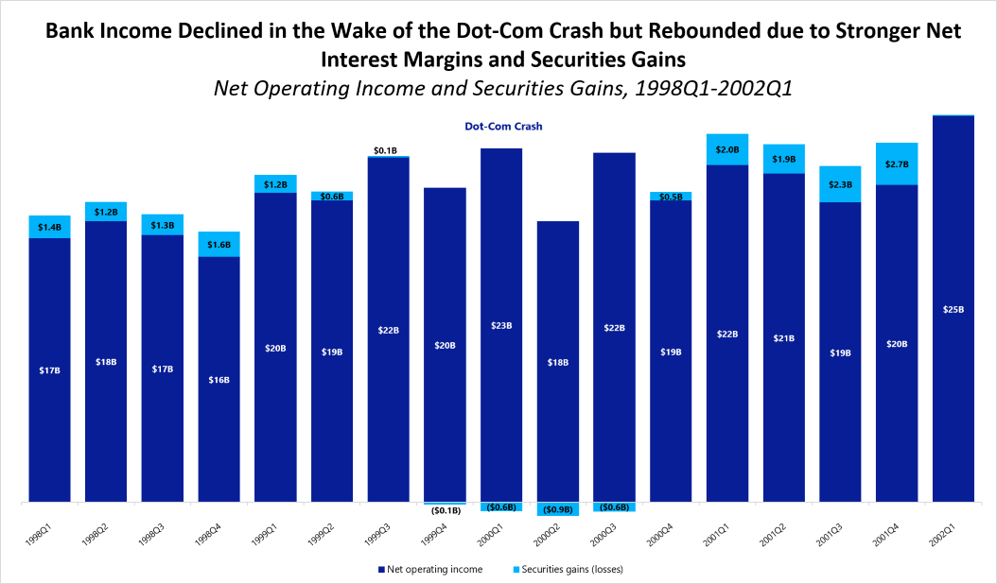
Problem banks increased from 76 in mid-1999 to 146 by September 2002,[17] but failures peaked at just 11 institutions in 2002,[18] mostly because of idiosyncratic credit problems rather than technology exposure. NextBank, an internet-only credit card bank, was the failure most closely associated with the internet boom.[19]
Overall, the dot-com bust exposed pockets of weakness but did not threaten the stability of the banking system. Unlike the period before the GFC, banks entered the dot-com downturn with relatively strong balance sheets and were not burdened by excessive leverage or concentrated exposures.
Bank Performance: Divergence Beneath the Surface
Although the banking industry remained resilient overall, performance varied across business models.
Large and Complex Banks
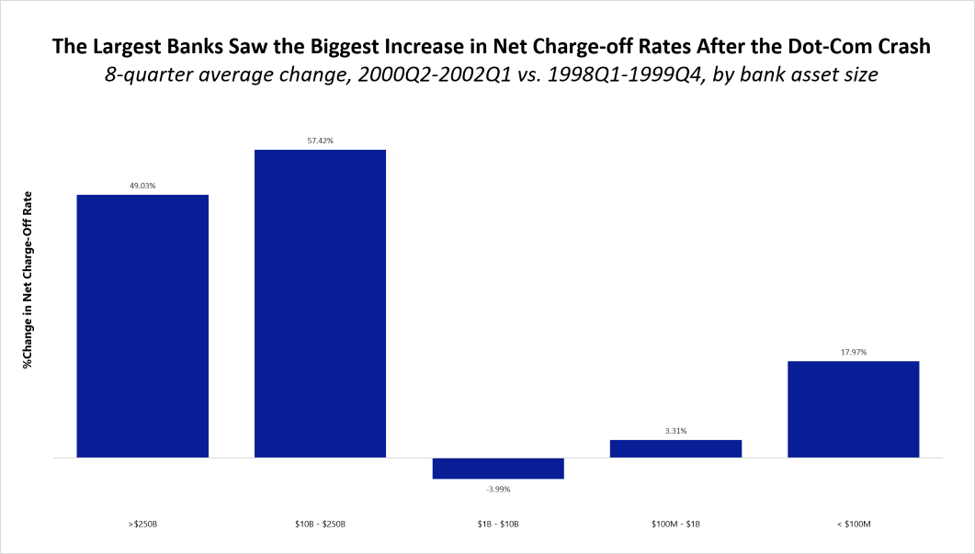
Large banks faced the greatest earnings pressure because of leveraged corporate lending and capital markets exposure.[20] Loan losses (see Chart 2), weaker IPO and M&A activity, litigation related to underwriting practices, and delayed reserve recognition all weighed on results.[21],[22]
CHART 2
Credit deterioration also was recognized gradually, with reserve build-up lagging the weakening in corporate credit quality (see Chart 3).
CHART 3

Regional and Community Banks
Regional and community banks generally performed better in the years following the dot-com bubble because they had limited exposure to speculative technology and telecom lending and were less dependent on capital markets activity. Mortgage refinancing supported many consumer-focused institutions after Federal Reserve rate cuts, although lower rates compressed margins.[23] Overall, credit losses and profitability declines remained modest.
Today’s Banking Conditions
Today, the banking industry appears to be in a stronger position than it was on the eve of the dot-com crash. Profitability is slightly higher, with a four-quarter average return on assets of 1.28 percent as of 2Q26 compared with 1.26 percent as of the 1Q00. Also, banks hold more capital, liquidity, and loan loss reserves than they did entering the previous cycle, suggesting greater resilience even as risks increasingly reside outside the traditional banking system.[24]
Policy Response Helped Support Banks
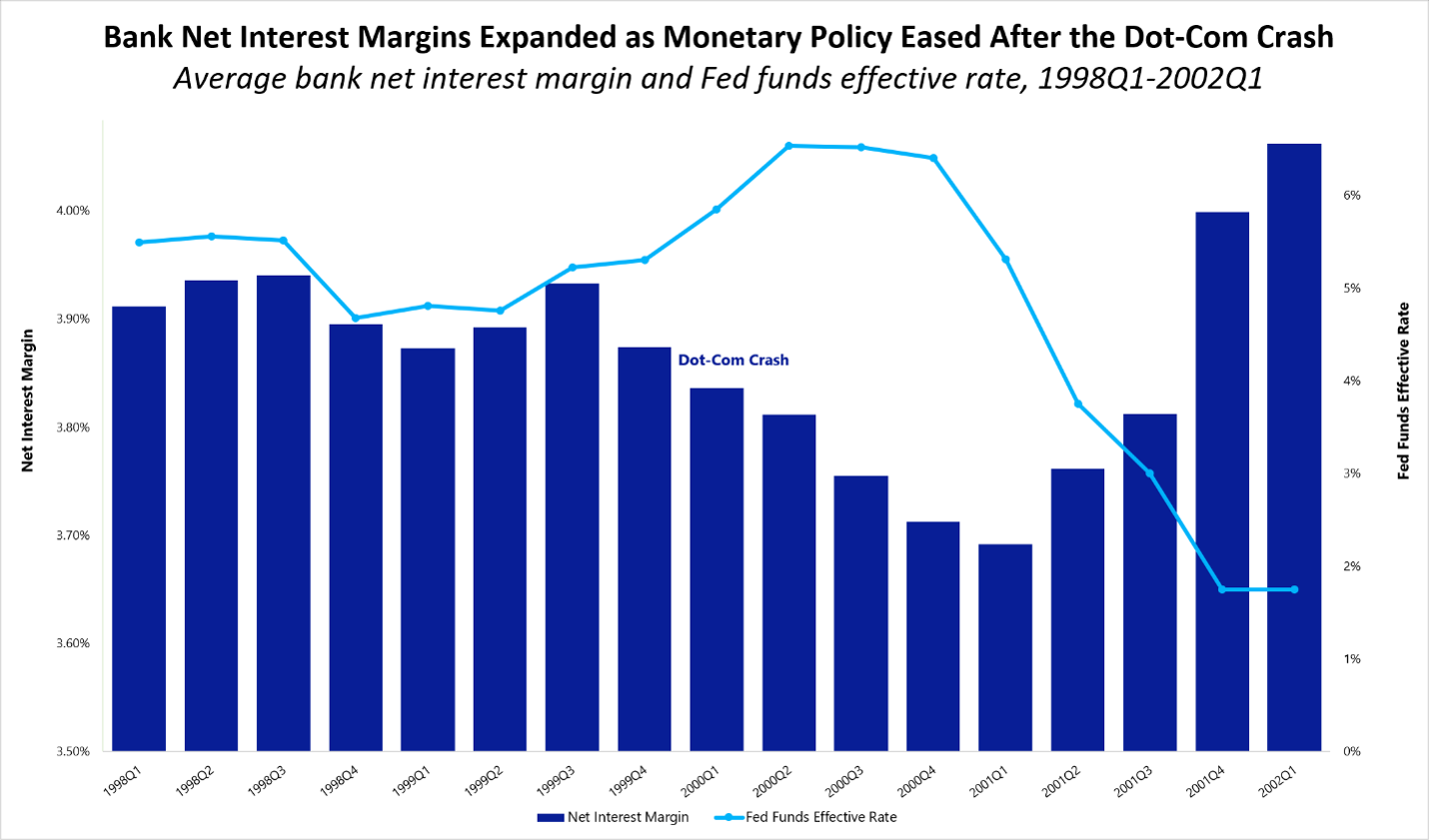
The policy response to the dot-com bust helped cushion the banking system. After tightening policy in 1999, the Federal Reserve reversed course in 2001, cutting rates 11 times by a total of 475 basis points, from 6.5 percent to 1.75 percent.[25]
The rate cuts steepened the yield curve, reduced funding costs, expanded net interest margins (NIMs) for many banks (see Chart 4), and generated securities gains as bond prices rose.
CHART 4
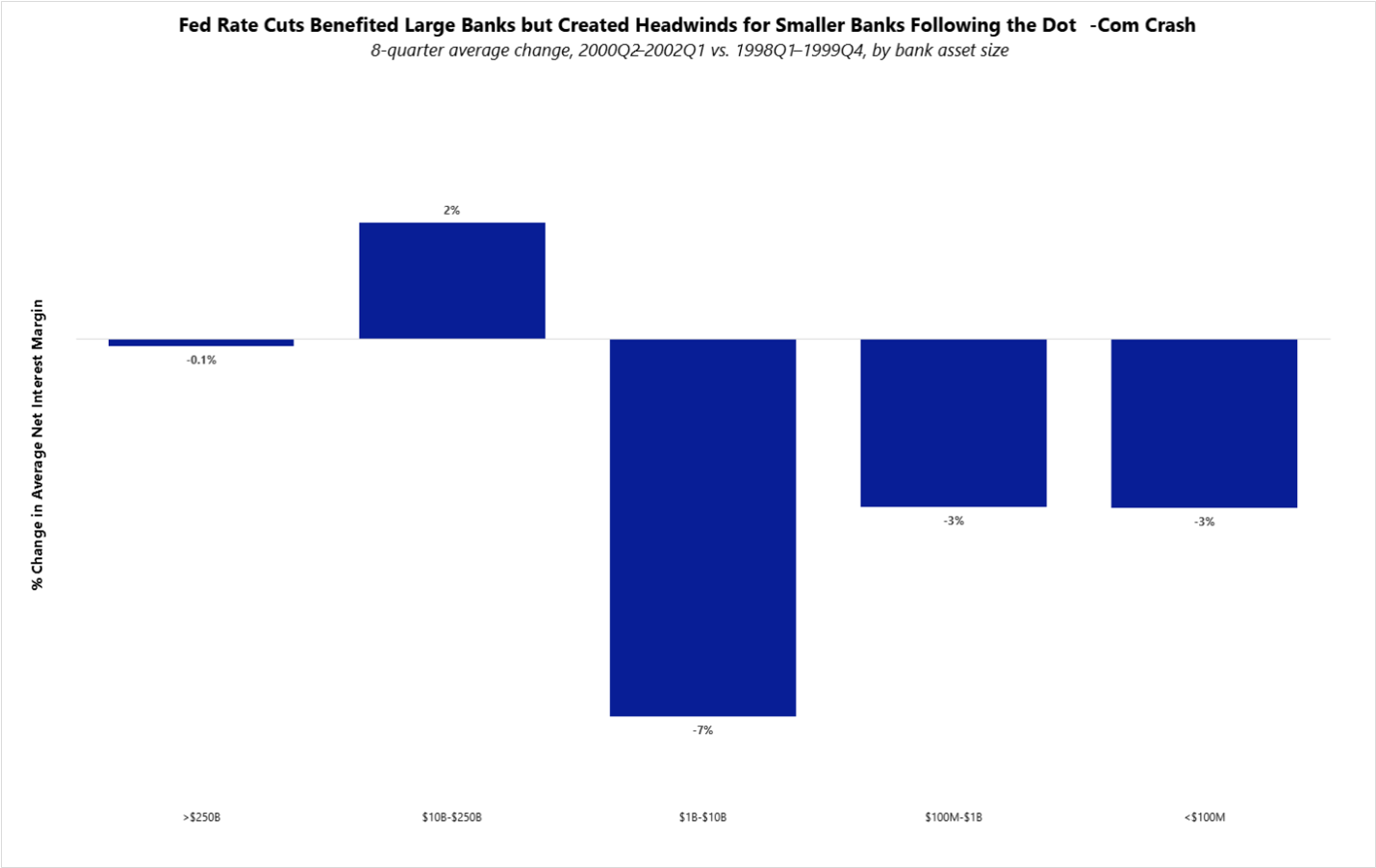
Smaller banks, however, benefited less initially, as their NIMs declined through much of 2001 (see Chart 5).
CHART 5
Beyond monetary policy, Congress provided fiscal support through the Economic Growth and Tax Relief Reconciliation Act of 2001, including $38 billion in tax rebates[26] as part of a broader $1.35 trillion tax cut.[27] Together, fiscal and monetary easing supported liquidity and a 6.6 percent compound annual growth rate in deposits from 2001-2003.[28]
Today’s policy backdrop may be less supportive. Higher public debt and lingering inflation risks could limit policymakers’ ability to respond as quickly or forcefully as they did in 2001. Also, the shift of credit intermediation to less transparent nonbank institutions without access to the federal safety net could make stress events harder to diagnose and contain.[29]
Nonbank Lending Plays a Bigger Role Today
The biggest difference today is that much more leverage resides outside traditional banks in private credit funds and other nonbank lenders. A market correction may emerge not through conventional commercial lending but through nonbank funding channels.
Bank lending to nondepository financial institutions has been the fastest-growing loan segment since the GFC. Outstanding balances reached $1.5 trillion as of June 30, 2026, representing 10.9 percent of total bank loans and leases, up from 3.2 percent a decade earlier.[30] Including these loans raises banks’ effective exposure to commercial credit to roughly 29 percent of total loans, exceeding commercial and industrial loan concentrations during the dot-com era.[31]
Much of this exposure is concentrated at the largest banks and includes lending to private equity funds, mortgage finance companies, business and consumer credit intermediaries, and other leveraged financial entities.[32]
A severe market correction could produce credit losses on banks’ loans to nonbank intermediaries, reduce collateral values, and trigger liquidity draws or even result in fire-sales, which put further downward pressure on asset values. [33] Unlike 2000, stress could spread through more opaque funding channels, where valuations are set by managers without the benefit of observable market prices[34] and complexity and data gaps may expose banks to risks that are more difficult to monitor and measure.[35]
Conclusion
The dot-com crash suggests that the impact on banks of a sharp equity correction depends less on the size of the market decline than on how risk is transmitted through the financial system. Banks with significant exposure to affected sectors, capital-markets, or other vulnerable financing channels are likely to be hit hardest, while institutions with diversified earnings, stable deposits, and strong capital should prove more resilient.
The biggest unknowns today are whether policymakers will have the flexibility to respond as aggressively as they did in 2001 and how private credit markets will perform under stress.
For bank management, the key question is not whether technology valuations resemble the dot-com era, but whether today's financing structure has created exposures that are less visible and therefore harder to identify, monitor, and manage under stress.
Endnotes
- Yun Li, “Michael Burry Says the Market Today Feels Like ‘the Last Months of the 1999–2000 Bubble,’” CNBC, May 8, 2026, https://www.cnbc.com/2026/05/08/michael-burry-says-the-market-today-feels-like-the-last-months-of-the-1999-2000-bubble.html.
- Reuters, “U.S. Tech Stocks’ Market Dominance Reaches New Heights, Presents New Risks,” June 3, 2026, https://www.reuters.com/business/us-tech-stocks-market-dominance-reaches-new-heights-presents-new-risks-2026-06-03/.
- Patturaja Murugaboopathy, “AI Spending Spree Drives Global Tech Debt Issuance to Record High,” Reuters, December 22, 2025, https://www.investing.com/news/stock-market-news/ai-spending-spree-drives-global-tech-debt-issuance-to-record-high-4419755?utm_source.
- Jay R. Ritter, “IPO Statistics for 2025 and Earlier Years,” IPO Data, University of Florida, table 9, 35, accessed October 8, 2026, https://site.warrington.ufl.edu/ritter/ipo-data/.
- “S&P: Bank Ratings Likely to Weather Telecom Woes,” American Banker, accessed October 8, 2026, https://www.americanbanker.com/news/s-amp-p-bank-ratings-likely-to-weather-telecom-woes.
- “Citigroup Settles Enron Lawsuit for $2 Billion,” PBS NewsHour, June 10, 2005, https://www.pbs.org/newshour/politics/law-jan-june05-citigroup_06-10.
- Ritter, “IPO Statistics for 2025 and Earlier Years,” table 9, 35.
- Chris Perry, “More Private Tech Companies Means Less Information for Investors,” Forbes, February 9, 2026, https://www.forbes.com/sites/chris-perry/2026/02/09/more-private-tech-companies-means-less-information-for-investors/.
- LPL Research, “Using the Late ’90s as a Comp: The AI Boom Still Has Legs,” accessed October 8, 2026, https://www.lpl.com/research/blog/using-the-late-90s-as-a-comp-the-ai-boom-still-has-legs.html.
- Berber Jin, “An Inside Look at OpenAI and Anthropic’s Finances Ahead of Their IPOs,” Wall Street Journal, accessed October 8, 2026, https://www.wsj.com/tech/ai/openai-anthropic-ipo-finances-04b3cfb9.
- Reuters, “Global Software Stocks Hit by Anthropic Wake-Up Call on AI Disruption,” February 4, 2026, https://www.reuters.com/business/media-telecom/global-software-stocks-hit-by-anthropic-wake-up-call-ai-disruption-2026-02-04/.
- Murugaboopathy, “AI Spending Spree.”
- Federal Deposit Insurance Corporation, Bank Lending to Nondepository Financial Institutions, accessed October 8, 2026, https://www.fdic.gov/analysis/bank-lending-nondepository-financial-institutions.pdf.
- “The Dotcom Bubble Burst (2000),” International Banker, accessed October 8, 2026, https://internationalbanker.com/history-of-financial-crises/the-dotcom-bubble-burst-2000/#:~:text=domain%20,5%20trillion%20in%20market%20value.
- Federal Deposit Insurance Corporation, “Corporate Earnings Growth Suggests Business Sector Recovery,” FYI, September 5, 2002, https://www.fdic.gov/analysis/archived-research/fyi/090502fyi.pdf.
- Federal Deposit Insurance Corporation, Quarterly Banking Profile, fourth quarter 2001, https://www.fdic.gov/analysis/quarterly-banking-profile/qbp/archive/qbp-2001-4qtr.pdf.
- Federal Deposit Insurance Corporation, Quarterly Banking Profile, third quarter 2002, https://www.fdic.gov/analysis/quarterly-banking-profile/qbp/2002dec/qbp.pdf.
- Federal Deposit Insurance Corporation, Quarterly Banking Profile, fourth quarter 2003, https://www.fdic.gov/analysis/quarterly-banking-profile/qbp/2003dec/qbp.pdf.
- Federal Deposit Insurance Corporation, “NextBank, N.A., Phoenix, Arizona,” accessed October 8, 2026, https://archive.fdic.gov/view/fdic/2217.
- Office of the Comptroller of the Currency et al., 2001 Shared National Credit Review.
- Federal Deposit Insurance Corporation, Quarterly Banking Profile, third quarter 2001, https://www.fdic.gov/analysis/quarterly-banking-profile/qbp/archive/qbp-2001-3qtr.pdf.
- Federal Deposit Insurance Corporation, Quarterly Banking Profile, fourth quarter 2001.
- Federal Deposit Insurance Corporation, Quarterly Banking Profile, fourth quarter 2001.
- Federal Deposit Insurance Corporation, Quarterly Banking Profile, second quarter 2026, August 25, 2026, https://www.fdic.gov/quarterly-banking-profile/quarterly-banking-profile-2q-2026#charts-and-data.
- Miranda Marquit, “Federal Funds Rate History 1990 to 2026,” Forbes Advisor, accessed October 8, 2026, https://www.forbes.com/advisor/investing/fed-funds-rate-history/.
- Matthew D. Shapiro and Joel Slemrod, “Consumer Response to Tax Rebates,” University of Michigan, accessed October 8, 2026, https://websites.umich.edu/~shapiro/Shapiro-Slemrod-TPE-PostConferenceDraft.pdf.
- Economic Growth and Tax Relief Reconciliation Act of 2001, Pub. L. No. 107-16, 115 Stat. 38, https://www.taxnotes.com/research/federal/legislative-documents/public-laws-and-legislative-history/economic-growth-and-tax-relief-reconciliation-act-of-2001-p.l/drsm.
- Federal Deposit Insurance Corporation, BankFind Suite: Financial Reporting, accessed October 8, 2026, https://banks.data.fdic.gov/bankfind-suite/financialreporting.
- Martin J. Gruenberg, “Financial Stability Risks of Nonbank Financial Institutions,” speech at the Exchequer Club, September 20, 2023, https://www.fdic.gov/news/speeches/2023/spsept2023.html.
- Federal Deposit Insurance Corporation, BankFind Suite: Financial Reporting.
- Federal Deposit Insurance Corporation, BankFind Suite: Financial Reporting.
- Federal Deposit Insurance Corporation, Bank Lending to Nondepository Financial Institutions.
- Federal Deposit Insurance Corporation, Bank Lending to Nondepository Financial Institutions.
- “Banks Are Pretending Not to Notice a Big Problem with Private Credit,” American Banker, accessed October 8, 2026, https://www.americanbanker.com/opinion/banks-are-pretending-not-to-notice-a-big-problem-with-private-credit.
- “BIS Releases Report on Connections between Banks and Nonbanks,” ABA Banking Journal, July 11, 2025, https://bankingjournal.aba.com/2025/07/bis-releases-report-on-connections-between-banks-and-nonbanks/.


