


Deposit Competition is Poised to Intensify
Key Takeaways
- Regulatory capital relief finalized and proposed in 2025–2026 is set to free nearly $300 billion in Tier 1 capital at U.S. depository institutions, implying $3.4 to $4.7 trillion in potential balance-sheet expansion.
- That expansion must be funded, and deposits are the most likely source.
- Even conservative deployment scenarios imply deposit demand well above recent growth trends.
- GSIBs, which already hold roughly 42 percent of domestic deposits, could create competitive pressure across the entire banking industry due to capital relief—including for banks not seeking to expand their own balance sheets.
- How competition develops—across pricing, term, product features, or even via increased merger activity—remains uncertain.
Bank deposit competition is likely to intensify as regulatory capital relief increases banks’ capacity to expand balance sheets. Recently finalized or proposed capital changes could free up as much as $300 billion in Tier 1 capital at U.S. depository institutions. Even at conservative deployment rates, that relief implies potential balance sheet expansion of $3.4 to $4.7 trillion—growth that must be funded. The most likely funding source is deposits. Most market commentary has focused on how capital relief may affect lending and asset-mix decisions or on broader financial stability implications. The deposit implications have received far less attention.
Our review of regulatory analyses suggests that reduced capital constraints will cause a structural increase in banks’ demand for deposits. And unless economic conditions generate a surge in new deposit creation (i.e., through lending), or funds flow back into the banking system from nonbank alternatives, banks are likely to compete more aggressively for a relatively limited pool of deposits.
Capital Relief Has Meaningfully Increased Balance Sheet Capacity
Since last November, federal banking regulators have finalized and proposed four rules that would provide capital relief to banks. For each rule, they estimate the effect on capital at the holding company or bank-subsidiary level, as applicable. The sections that follow review each of the four rules and their estimated effects on Tier 1 capital requirements or balance sheet capacity for insured depository institutions where deposit demand is most directly affected.
Rule 1: eSLR Reform: The Most Consequential Change for Balance Sheet Expansion
The most consequential change for balance sheet expansion is the finalized reform of the Enhanced Supplementary Leverage Ratio (eSLR). This rule, which was finalized in November 2025 and became effective April 1, 2026, applies to the eight U.S. GSIBs and covered bank subsidiaries.1 A key objective of the rule was to make the leverage requirement less likely to constrain a GSIB’s balance sheet, thereby reducing capital-related disincentives to engage in low-risk, low-return activities, such as U.S. Treasury market intermediation and investment.2
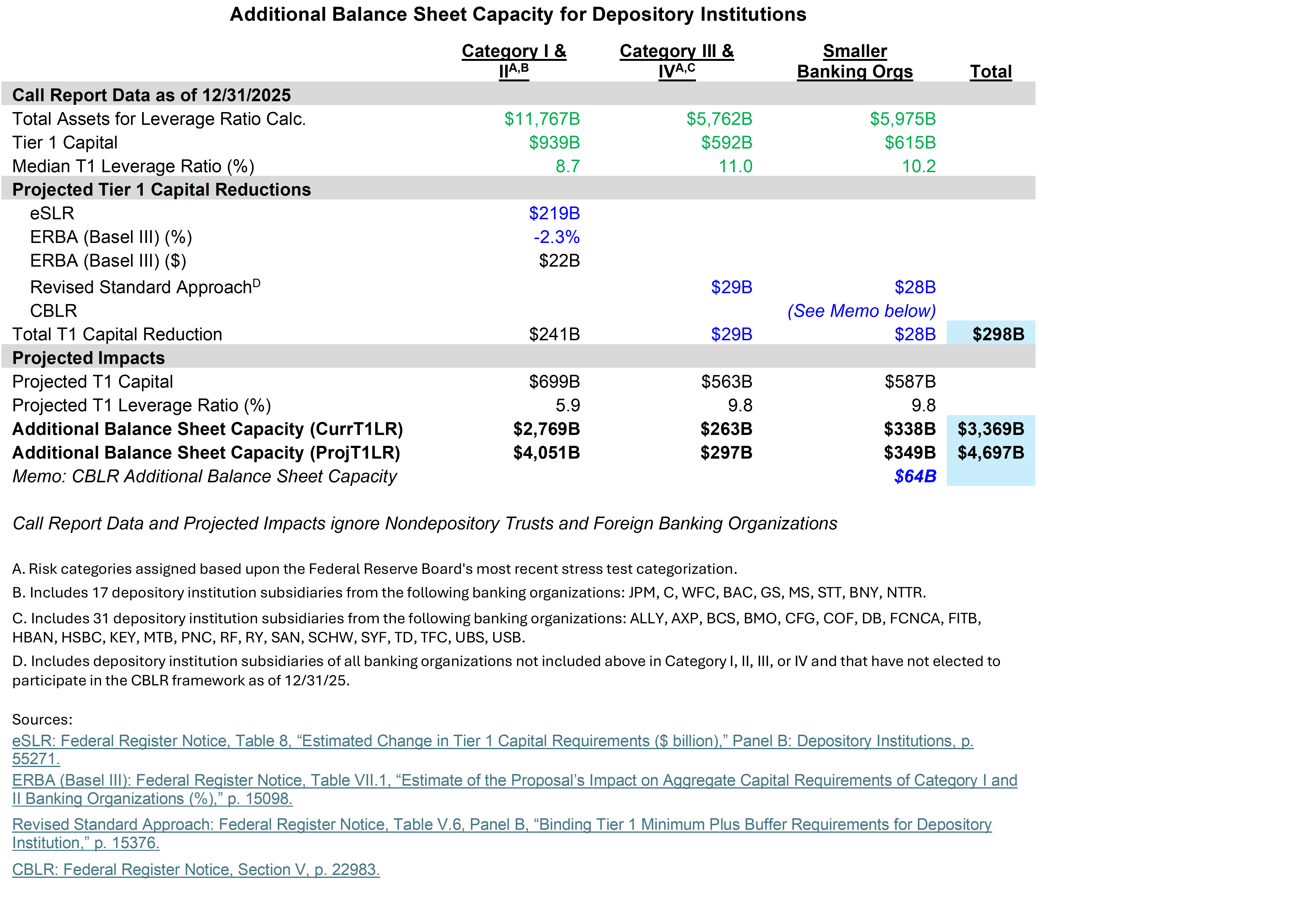
Although relief at the holding company level appears modest,3 the effect at the insured depository institution level should be substantial. Regulators estimate a roughly 28 percent reduction in Tier 1 capital requirements, freeing approximately $219 billion in aggregate.4
Some analysts translate this relief into as much as $5.5 trillion of potential balance sheet expansion if GSIBs and other eSLR-covered banks maximize leverage under the revised requirement.5 In practice, however, other constraints, such as stress test constraints, internal risk limits, and the cost and availability of funding are likely to limit balance sheet growth before the revised eSLR becomes the binding constraint.
At leverage ratios consistent with current practice, roughly 10x to 12x, the freed capital implies approximately $2.2 trillion to $2.6 trillion of potential balance sheet capacity at GSIBs alone. Those figures are consistent with Treasury Secretary Scott Bessent’s cited estimate of $2.5 trillion in additional lending capacity resulting from the Trump administration’s deregulatory actions.6
Rule 2: CBLR Reform: Capital Relief Extends to Community Banks
Capital relief is not limited to the largest banks. In April 2026, federal banking regulators finalized a rule lowering the Community Bank Leverage Ratio (CBLR) threshold from nine percent to eight percent, expanding eligibility for the simplified capital framework.7
Today, about half of currently eligible community banks have opted into the CBLR framework. Regulators estimate that the lower threshold could allow several hundred additional banks to qualify and could support approximately $64 billion in incremental balance sheet expansion.8 While modest relative to the eSLR relief for GSIBs, the relief provided by the CBLR final rule could still increase deposit demand pressures across the banking system by giving community banks more room to grow. This rule becomes effective on July 1, 2026.
Rule 3: Basel III Endgame: Additional Relief for the Largest Banks
At the end of March, federal banking regulators proposed a new version of the Basel III endgame, called the Expanded Risk-Based Approach (ERBA), which would apply to the largest and most complex banking organizations and those with significant trading activity.9 This proposal departs notably from the prior administration’s approach, which would have increased capital by 15 to 20 percent for the largest U.S. holding companies.
By contrast, regulators estimate that the ERBA, if implemented as proposed, would reduce Tier 1 capital requirements at depository institution subsidiaries by 2.3 percent.10
Rule 4: Revised Standardized Approach: Broader Relief for Mid-Size and Smaller Banks
Concurrently with the Basel III proposal in March, federal banking regulators also proposed changes to the standardized approach, which is the risk-based capital framework used by most banking organizations that report risk-weighted assets.
These proposed changes would produce larger reductions in binding Tier 1 capital requirements at depository institution subsidiaries: approximately $29 billion, or 7.8 percent for Category III and IV banks, and approximately $28 billion, or 7.2 percent, for smaller banks.11
Regulatory Estimates Imply a Range of Potential Balance Sheet Expansion Scenarios
Together, these regulatory changes imply a meaningful increase in potential balance sheet capacity across the banking system.
As shown in Table 1, these four rules are estimated to provide roughly $300 billion in cumulative Tier 1 capital relief for insured banks. Assuming banks deploy this capacity at current leverage ratios, total potential balance sheet growth would be approximately $3.4 trillion to $4.7 trillion.
Almost three-quarters of the estimated capital relief comes from changes to the eSLR, which applies only to GSIBs and is intended to increase incentives to hold zero- risk-weighted assets, particularly U.S. Treasury securities. Initial expansion is therefore likely to be concentrated among the largest banks, which will need stable, low-cost funding to grow their securities portfolios.
This analysis excludes holding company effects from these and other proposals, such as the GSIB surcharge and stress-test changes, which could also indirectly increase balance sheet capacity and deposit demand.
How Banks Are Likely to Deploy Capital Relief
Capital Distributions: Likely Impacted by Regulatory Constraints
Capital relief is unlikely to translate immediately into a large increase in dividends or share repurchases.
Following last summer’s stress test results, most of the largest banks increased dividends and share repurchases.12 But eSLR relief is different. Regulators generally do not view leverage-ratio recalibration as a meaningful driver of capital distributions, because the relief is limited at the holding company level and does not, by itself, affect Common Equity Tier 1 capital requirements.13 In addition, stress capital buffer requirements and related payout constraints remain in place and may continue to limit distributions.
Other capital changes could eventually create more flexibility. Regulators estimate that Common Equity Tier 1 requirements for covered holding companies would decline by about $87.7 billion.14 Some of that capital may ultimately be returned to shareholders, but the amount and timing remain uncertain.
Increasing Lending: Regulatory Intent Is Clear, but Loan Growth Will Be Gradual
Federal banking regulators have made clear that part of the goal of recent capital changes is to support lending. Changes such as the ERBA and revised standardized approach are intended to reduce capital burdens on certain types of lending, including mortgage and small-business lending. Other policy shifts, including the OCC’s and FDIC’s withdrawal of the 2013 leveraged lending guidance, may also modestly increase banks’ willingness to take credit risk.15, 16
Even so, loan growth is not automatic. Banks will need sufficient demand, acceptable credit quality, and a supportive macroeconomic environment. As such, any increase in lending is likely to develop gradually rather than all at once.
Purchasing U.S. Treasuries and Other Securities: The Most Immediate Use of Freed Capacity
The most immediate response of freed balance sheet capacity is likely to be increased securities holdings, especially U.S. Treasuries, and expanded repo activity.17
This is particularly true for GSIB affiliates. The eSLR changes give these institutions more flexibility to hold low-risk assets and support Treasury market intermediation. Even if GSIBs are not currently tightly constrained, additional leverage flexibility could make them more willing to expand Treasury and repo activity. To support larger securities portfolios, banks will need access to stable and competitively priced funding. Deposits are likely to remain an important part of that funding mix.
Asset Growth Creates Demand for Deposits
Whether banks use the new capacity to buy securities, expand repo activity, or eventually increase lending, balance sheet growth requires stable, low-cost funding. That dynamic sets the stage for intensified deposit competition, particularly among GSIBs and other large banks that choose to deploy newly available balance sheet capacity. Without stronger credit demand driving deposit creation, banks will need to compete for existing deposits to fuel growth.
Short-term wholesale funding, particularly repo financing backed by Treasury collateral, may offset some deposit demand. It is unlikely, however, to eliminate the need for deposits if balance sheet expansion becomes widespread, given internal risk limits and banks’ preference for more stable funding sources.
This could increase competition for deposits across the banking system. GSIBs already control roughly 42 percent of domestic deposits.18 More aggressive deposit gathering by these institutions could help set the marginal price of funding and increase competitive pressure for deposits across the industry, including for banks that are not expanding balance sheets aggressively.
Deposit Demand Could Exceed Recent Growth Trends
Growth is likely to be gradual as banks gain regulatory certainty and adjust their strategies, with loan growth across the industry following over time. However, even under conservative assumptions, the resulting demand for deposits could exceed recent deposit growth trends.
Table 2 shows estimated deposit demand based on $4 trillion in desired asset growth, the midpoint of the range in Table 1.
TABLE 2

Since the fourth quarter of 2023, domestic deposits have grown by approximately $1.1 trillion, following an industry-wide decline in 2022.19 By contrast, the asset growth scenarios shown above would require deposit growth comparable to the surge that occurred in 2020, when extraordinary fiscal and monetary stimulus in response to the COVID-19 pandemic drove a sharp increase in system-wide liquidity.20
What This Means for Bank Executives
Capital relief has materially eased constraints on balance sheet expansion and is likely to reshape competition for bank funding. The extent of banks’ appetite for growth will depend on broader macroeconomic and financial conditions. Even so, partial deployment of GSIB capacity is likely to intensify competition for deposits, with pricing effects that spill across the banking industry as deposit flows adjust.
For bank executives, the key issue is funding. If large banks deploy even part of their newly available capacity, competition for deposits could intensify. Large institutions may try to attract deposits from nonbanks, compete more directly with other banks on price, term, convenience, or other features. Another possibility is that larger banks pursue growth through acquisitions.
These trends bear watching.
Endnotes
1 https://www.govinfo.gov/content/pkg/FR-2025-12-01/pdf/2025-21626.pdf. The final rule recalibrates the eSLR buffer to 50 percent of a GSIB’s method 1 surcharge calculated under the FRB’s GSIB surcharge framework, replacing the current two-percent leverage buffer. For bank subsidiaries, the final rule adopts an eSLR buffer standard equal to 50 percent of the parent GSIB’s method 1 surcharge, capped at one percent and applied in addition to the three-percent minimum SLR requirement, replacing the six percent “well-capitalized” prompt corrective action threshold.
2 www.fdic.gov/board/eslr-frn-final-rule-2025.pdf, pg. 55248.
3 https://www.govinfo.gov/content/pkg/FR-2025-12-01/pdf/2025-21626.pdf, pgs. 55270-55271. Regulators estimate that aggregate Tier 1 capital requirements for GSIBs will fall by less than two percent, or roughly $13 billion, limiting the scope for growth in higher risk-weighted assets or capital distributions.
4 Ibid.
5 https://www.reuters.com/sustainability/boards-policy-regulation/fed-plan-ease-leverage-rule-offers-windfall-big-us-banks-morgan-stanley-says-2025-06-26/.
6 https://www.politico.com/news/2026/01/24/scott-bessent-banks-00744468
7 https://www.govinfo.gov/content/pkg/FR-2026-04-29/pdf/2026-08298.pdf. The rule also extends the CBLR grace period for banks that fall below the threshold, allowing up to four quarters to return above eight percent, rather than two quarters, provided they remain above seven percent.
8 https://www.govinfo.gov/content/pkg/FR-2026-04-29/pdf/2026-08298.pdf, pg. 22983. Regulators did not provide an estimate of the effect on capital requirements. Rather, they provided the estimate of $64B in additional balance sheet capacity.
9 Viewed in isolation, the ERBA would increase Tier 1 capital requirements by 1.6 percent for Category I and II bank holding companies. However, the Federal Reserve has concurrently proposed changes to the GSIB surcharge. Together with the Federal Reserve Board’s October 2025 proposal to revise its stress-test framework, these changes are expected to reduce Tier 1 capital requirements by about 3.7 percent for these holding companies. https://www.govinfo.gov/content/pkg/FR-2026-03-27/pdf/2026-05959.pdf, pg. 15098 and 15101. https://www.govinfo.gov/content/pkg/FR-2026-03-27/pdf/2026-05961.pdf
10 https://www.govinfo.gov/content/pkg/FR-2026-03-27/pdf/2026-05959.pdf, pg 15098.
11 https://www.govinfo.gov/content/pkg/FR-2026-03-27/pdf/2026-05960.pdf, pg. 15376
12 https://www.bankingdive.com/news/bank-dividend-increase-stress-capital-buffer-fed-jpmorgan-goldman-wells-morgan-stanley/752226/.
13 https://www.fdic.gov/board/eslr-frn-final-rule-2025.pdf, pg. 55277.
14 https://www.govinfo.gov/content/pkg/FR-2026-03-27/pdf/2026-05959.pdf, pg. 15128
15 Interagency Statement on OCC and FDIC Withdrawal from the Interagency Leveraged Lending Guidance Issuances (Dec 5, 2025), available at: https://www.fdic.gov/news/press-releases/2025/interagency-statement-occ-and-fdic-withdrawal-interagency-leveraged.
16 As with capital distributions, regulators expect eSLR changes to provide only limited additional capacity for non-zero-risk-weighted assets at the holding company level, as the reduction in Tier 1 capital requirements is expected to be modest. However, conforming changes to the total loss-absorbing capacity standard and long-term debt requirements could marginally lower GSIB funding costs, supporting lending at the margin: https://www.govinfo.gov/content/pkg/FR-2025-12-01/pdf/2025-21626.pdf, pgs 55280-55281.
17 https://www.govinfo.gov/content/pkg/FR-2025-12-01/pdf/2025-21626.pdf.
18 Call Reports, 12/31/25
19 Call Reports
20 Ibid


